




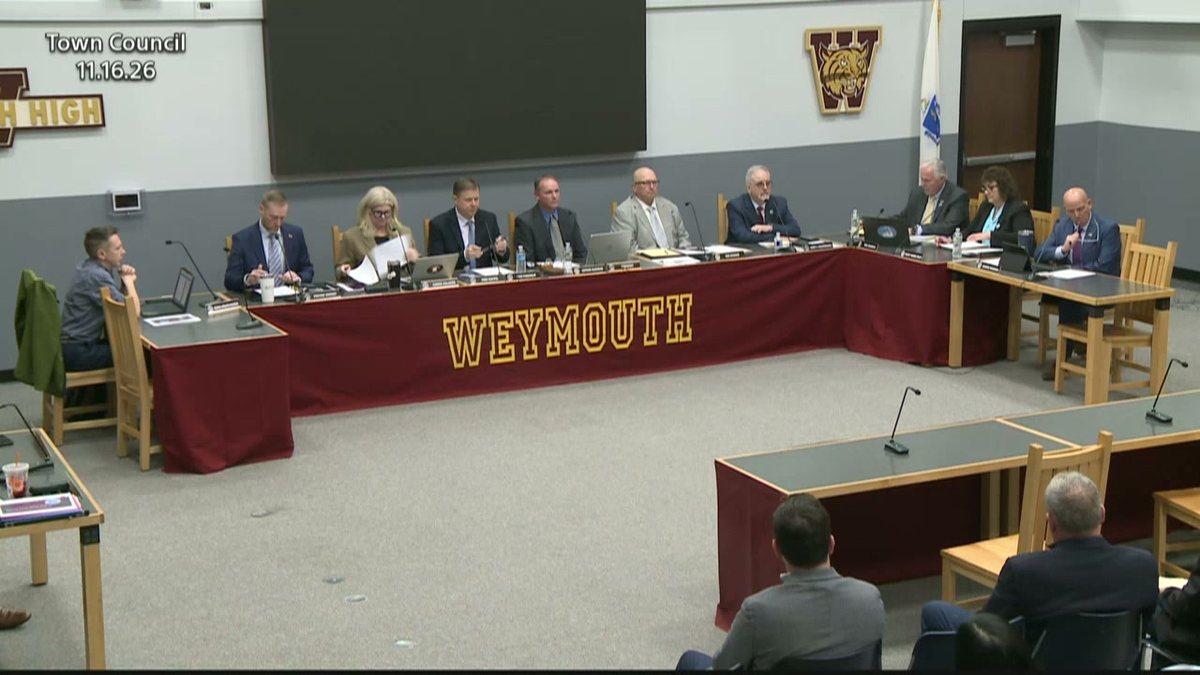
Weymouth homeowners will keep getting the same break on their tax bills next year, after the Town Council voted 10-0 Monday night to again shift part of the property tax load onto businesses at the 146% factor the town's assessors recommended.
The council then turned to the town's Flock license plate reader cameras, which several residents asked it to shut off. Councilors voted 10-0 to send the question of what the cameras cost and how they were paid for to the council's Budget/Management Committee, after the committee's chair said the system costs $98,500 a year and was never put to the council as a budget item.
The meeting was held at the Mary Jo Livingstone Humanities Center at Weymouth High School while the Town Hall elevator is replaced, and all councilors but Christopher Heffernan, who was absent, took part.
The tax split
The council adopted measure 26 119, a 1.46 shift for commercial, industrial and personal property with no residential exemption for fiscal 2027, after Councilor Gary MacDougall reported that his Budget/Management Committee had voted 5-0 earlier in the evening to recommend it. No one from the public spoke at the hearing.
Principal Assessor Patricia O'Kane told councilors the board recommended keeping the shift the same because values rose about 3% for the average single-family home and about 2% for the average condominium. "By keeping the shift the same, I think we're being fair to both classes of property," she said, adding that the rates would change by "a couple of cents."
The assessors' hearing packet estimates the residential rate at $10.10 per $1,000 of value and the business rate at $15.83, against this year's $10.12 and $15.85. The average single-family home, valued at $631,458 for fiscal 2027, would owe about $6,377.73, up $169.25, or 2.73%, the packet shows. At a single rate for every class, the same home would owe about $6,845, so the shift keeps about $467 off the average homeowner's bill, by our math from the town's table.
The shift does not change how much the town collects in property taxes, only who pays it. The rates are still estimates until the state Department of Revenue approves the town's tax rate.
Homeowners who qualify can still cut their own bills with personal exemptions, which must be applied for every year, according to the town's Real Estate Tax Exemptions page. They include $1,000 off for owners 65 or older who meet income and asset limits, $350 off for owners 70 or older with assets up to $50,740, $800 or more off for veterans with a service-connected disability of 10% or more, and $875 off for legally blind owners. A taxpayer gets only the largest exemption they qualify for, and owners 65 or older with income up to $40,000 can put off paying their taxes under a deferral program, the page says.
Flock cameras
MacDougall said he asked the administration for the Flock contract on Sept. 24 and did not get it, that a resident obtained it through a public records request and shared it with him, and that the administration answered his written questions on Oct. 29.
He said the system costs $98,500 a year and that both years were paid from the police detail account, so the council never saw it as a budget line. He said the town's contract ended June 30 and has its termination clause marked "omitted," while an order form signed by the police chief lists 36 months with automatic 24-month renewals, for a total of $295,500. "Those documents don't agree," he said. He also said the council was told in May that Weymouth's data is shared with other Massachusetts police departments and kept 30 days, and in October that there is no outside access and it is kept seven days. "If the policy changed, this council should know when and in writing," he said.
MacDougall noted the contract was signed before the current administration took office and said the administration "has been responsive and helpful" to him. He said body cameras, Tasers and cruisers all came to the council as spending requests, and Flock did not.
Council President Arthur Mathews, speaking as an individual councilor, said the only reference the council ever had was one line in a capital improvement program of more than 100 items, which the council accepted as a whole. He said he understands the cameras have helped police catch suspects, and that he has heard from residents on both sides. With no state or federal law yet regulating the technology, he said, "the town of Weymouth should consider pausing or suspending the contract with Flock."
Councilor Rick Coughlin said that if councilors want to look at how the cameras are used, rather than what they cost, the Public Safety Committee would be the better place. Councilor Kenneth DiFazio reminded viewers the cameras keep operating while the committee reviews them. Councilor Carrie Palazzo asked whether the review could include a public presentation from the police or the mayor's office, and MacDougall said the committee would look at "what we're paying for, how it works."
Weymouth police said Nov. 13 that a Flock alert led officers to an elderly man reported missing and endangered from Connecticut, the seventh missing person the department has found with the technology.
During resident comment, four people spoke against the cameras, including a Weymouth High School student who said a petition against them has more than 720 signatures. Speakers raised concerns about privacy, how long the data is kept and who can search it, and asked the council to have the cameras turned off and covered while it reviews the contract.
Data center pause stays open
The council continued its public hearing on a proposed one-year moratorium on data centers, measure 26 115, to its Dec. 7 meeting on a 10-0 vote. Mathews said the council still needs a recommendation from the Planning Board, which has not held its own hearing, and that because the measure is a zoning change, the council cannot take more testimony once its hearing closes. Keeping it open lets residents send written comments.
The town solicitor, speaking for Mayor Michael Molisse, said the town wants the year to study what data centers could mean for its water, noise and other effects on residents. Seven residents spoke against data centers in Weymouth, and a letter read into the record asked the town to add public listening sessions to the study.
The council also sent a $100,000 gift for playground improvements at the Frederick C. Murphy Elementary School to the Budget/Management Committee.
The council meets next on Monday, Dec. 7, at the high school. Residents can email the council at towncouncil@weymouth.ma.us or call 781-340-5020, and WETC posts meetings on its Town Council playlist at weymouth.tv.
Label: Reported by us.
Corrections
No corrections to this story. If something here is wrong, tell us. Every correction is dated on the story and listed in our public log.
Sources (7)
- Weymouth Town Council meeting, Nov. 16, 2026, WETC
- Town Council agenda, Nov. 16, 2026, Town of Weymouth
- Budget/Management Committee agenda, Nov. 16, 2026, Town of Weymouth
- Measure 26 119, Fiscal Year 2027 Tax Classification, and hearing packet, Town of Weymouth
- Real Estate Tax Exemptions, Weymouth Assessor's Office, Town of Weymouth
- Measure 26 115, Temporary Moratorium on the Construction of Data Centers, Town of Weymouth
- "Weymouth Police Locate Seventh Missing Person with Assistance of ALPR Technology," Weymouth Police Department, Nov. 13, 2026