




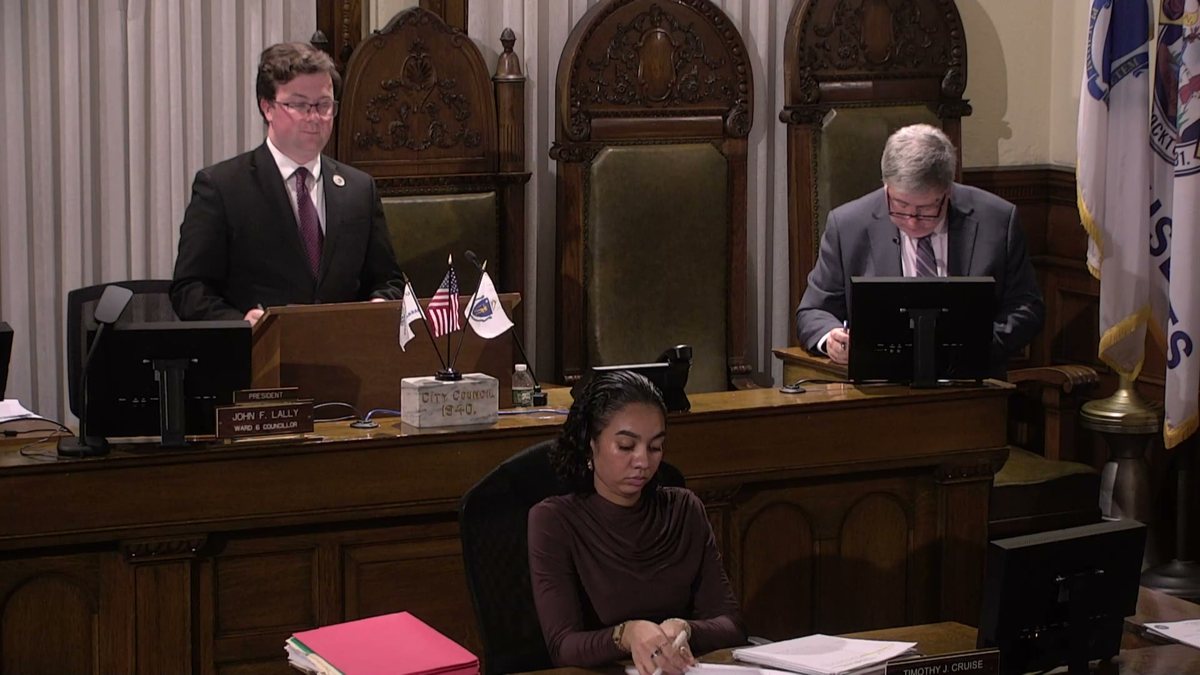
Brockton city councilors on Monday night set aside a call for the city to sue the state over zoning changes written into this year's state budget, after City Solicitor James O'Brien told them that working with the city's State House delegation was the better path.
The council's Finance Committee voted by voice to table the resolve, which asked Mayor Moises Rodrigues to have the Law Department challenge the changes in court. At-large Councilor Winthrop Farwell Jr., who sponsored it, made the motion and said another resolve could come in January asking O'Brien to convene a meeting with members of the legislative delegation and Fire Chief Brian Nardelli to push for changes in the law.
"I completely agree that if we were to go into court, it's risky," Farwell said. "We'd have the weight of the state coming down on us."
The resolve had been postponed twice, from the committee's Sept. 21 and Oct. 19 meetings. It targeted Chapter 137 of the Acts of 2026, the state budget signed July 9, which also rewrote parts of the state Zoning Act. Among other things, the law changed the test for a zoning variance from "substantial hardship" to "practical difficulty," and it lets some older homes that do not meet today's lot size, frontage, lot coverage or floor area rules be extended or altered as of right, as long as the work meets current height, story and setback limits.
The solicitor's advice
O'Brien said he had spoken that morning with Farwell and, before that, with state Sen. Michael Brady about "seeking a legislative route to address the zoning amendments rather than litigation route."
He said the new variance standard is "a substantial change to the framework governing variances" and "does broaden the grounds for which relief may be sought," but that it "also expressly retains consideration of public health and safety." The law tells a zoning board to weigh the benefits to the applicant and the public, including the interest in producing housing, against the harm to the neighborhood's public health, safety and welfare.
Because the Legislature made the changes, O'Brien said, the city's most productive response is to work through its legislative delegation for targeted amendments. "The city has meaningful zoning authority, but it operates within the framework of valid state laws," he said.
He suggested bringing the city's planning, zoning, inspectional services and fire officials together to list their concerns and propose corrections, and working with other cities and towns that face the same changes. Asked whether any court had ruled on appeals under the amended law, O'Brien said he had searched and found no cases since July. A city ordinance, he said, "cannot conflict with the state law."
The fire chief's concerns
Nardelli told councilors he came "wearing two hats," as fire chief and as vice chair of the Zoning Board of Appeals, speaking for board Chair Kenneth Galligan.
"I think I'm still scratching my head trying to figure out what that truly means," he said of the practical difficulty standard. He said that "we were never even notified that this legislation had passed until the building superintendent reached out to us," and that the board was then "scrambling to try to figure out what all of this meant."
His larger worry, he said, is the change for older buildings that do not meet today's rules. He said an owner could turn a three-family house into a six-family without changing the outside of the building, which would bring new alarm and sprinkler requirements and more cars on streets where fire trucks already struggle to get through, and he asked where all those cars would park.
Nardelli said the Fire Chiefs Association of Massachusetts was never consulted, and that the changes "flew under the cover of darkness through the budget." He also said fire chiefs will keep fighting a separate push, which he said is now moving through the state building code process, to allow apartment buildings of up to six stories with a single stairway, where the code now stops at three, a change he called "a non-starter with any fire chief in the Commonwealth of Massachusetts right now," pointing to the deadly Gabriel House fire. He said a Brockton ladder truck carries four firefighters, against seven in New York City, which he said has allowed single-stair buildings.
What councilors said
Farwell said he would like the solicitor, Nardelli, Galligan and a few councilors to sit down with the delegation after the new Legislature is sworn in, once the committee chairs are known. "I'm not an anti-housing person," he said. "Let's do it the right way and let's do it the safe way."
At-large Councilor Jeff Charnel, who said he served on the zoning board for almost five years, said he did not think the changes "all can be bad," pointing to owners who add units to a run-down building and must also add sprinklers and update the wiring, but he agreed that working with the delegation "is the way to go."
Ward 4 Councilor Susan Nicastro said gateway cities like Brockton, which are already dense, were "left out of the equation." She said she had liked the idea of a lawsuit but was willing to try the legislative route and offered to lobby other gateway cities to join. "This is a real problem for Brockton," she said.
Ward 1 Councilor Marlon Green said the state's goal of more housing is a good one, and that "we do need the housing, but we need safe housing."
The rest of the agenda
The committee's other votes are recommendations to the full City Council. Councilors recommended reappointing Linda R. Pietrantonio to the Beautification Committee and Robert P. Simpson Jr. to the License Commission. The appointment of William Forte as commissioner of buildings, for a three-year term set to begin Nov. 24, was postponed two weeks after Forte asked in a communication that afternoon that it be put off.
The committee backed accepting a $64,000 grant from the state Department of Environmental Protection for the Public Works refuse division. Public Works Commissioner Patrick Hill said the city scored 16 points in the state's recycling dividends program at $4,000 a point, and that the money pays for recycling supplies and for cameras the city uses to catch illegal dumping, including six it just bought.
Councilors also backed paying $24,901.86 in late bills from the past fiscal year for the parking department and $8,207.41 for the police department, and moving $5,000 into the auditor's overtime account.
The longest money debate was over a $30,000 transfer into the treasurer's overtime account. Treasurer Martin Brophy said it covers the city's Wednesday evening hours, three vacancies in his office and the January work on W-2 forms, and that "probably half of it" is for Wednesday nights. Farwell said he had no data showing whether the evening hours draw enough visitors, and with 33 Wednesdays left in the fiscal year he "would not look favorably upon further appropriations for Wednesday evenings." Green said the city should have set up a way to count how many more people the extra hours serve, and Ward 2 Councilor Maria Tavares asked departments to bring more detail with future requests. The transfer passed on Charnel's motion for the full amount.
The full City Council takes up the committee's recommendations at a later meeting. The council holds a special meeting Monday, Nov. 23, at 6 p.m. in the council chambers at City Hall for the fiscal 2027 tax classification hearing, which sets how the tax levy is split between homes and businesses. Residents can reach councilors through the City Council page at brockton.gov, and meetings air on Brockton Community Access and its YouTube channel.
Label: Reported by us.
Corrections
No corrections to this story. If something here is wrong, tell us. Every correction is dated on the story and listed in our public log.
Sources (6)
- Finance Committee agenda, Nov. 16, 2026, City of Brockton
- Brockton City Council Finance Committee meeting, Nov. 16, 2026, Brockton Community Access
- City Council members and committee assignments, City of Brockton
- Chapter 137 of the Acts of 2026, sections 40 to 49, The General Court of Massachusetts
- Public hearing notice for the Nov. 23, 2026, special City Council meeting, City of Brockton
- Brockton Community Access YouTube channel listing, "Brockton City Council Meeting 11-23-2026"