




PLYMOUTH, Mass. By the South Shore 360 Weather Desk
Plymouth has put Big Sandy Pond under a public health advisory for cyanobacteria, the blue-green algae that can make people sick and, the town warns, can be deadly to pets, according to a notice the town posted Thursday, Nov. 19.
The Plymouth Public Health Division issued the advisory after "visual observations provided by the Department of Energy and Environment indicate the presence of cyanobacteria (blue-green algae) cells," the town said. That evidence "suggests that the level of cyanobacteria in the water may exceed the Massachusetts Department of Public Health (MDPH) guidelines for recreational waterbodies," and the advisory follows the state agency's recommendation, according to the notice.
What people and pets should avoid
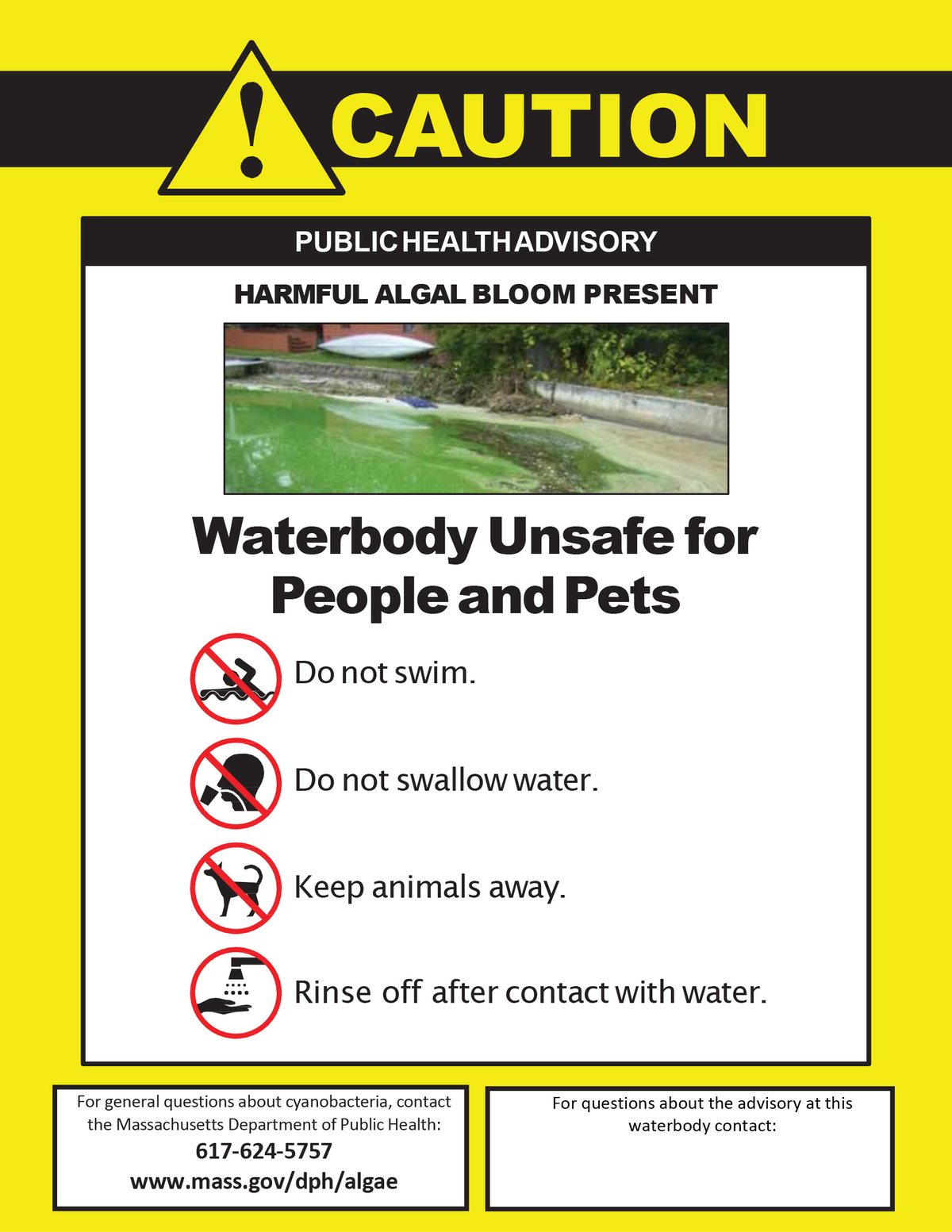
The state Department of Public Health advisory sign the town links from its pond page calls the water "Unsafe for People and Pets." It reads: "Do not swim. Do not swallow water. Keep animals away." It also tells anyone who touches the water to rinse off. State health guidelines, which the town also links from that page, call for an advisory against any contact with the water as soon as a visible scum or mat appears.
For dog owners, the town's guidance is to rinse an animal thoroughly if it goes into the water and to call a veterinarian if it drinks the water and shows signs of illness. "For pets and wildlife, exposure to cyanobacteria blooms can be deadly," a town fact sheet says, and it recommends washing a pet's paws and fur as soon as possible.
For people, the fact sheet lists stomach and intestinal symptoms, skin irritation, and neurological or liver problems as possible effects of exposure. Anyone exposed should shower as soon as possible, wash their clothing and call a health care provider if symptoms appear, it says. A bloom is not necessarily toxic, the town notes, but it treats every bloom as potentially toxic.
How long it lasts
The advisory has no set end date. "An advisory cannot be lifted until the bloom has been visibly clear for two consecutive weeks," the town said. The toxins are generally released as the cells die, which is why the advisory stays up for two weeks after a bloom fades, the fact sheet explains. The state guidelines make the same point: toxin levels in the water can rise for a time even as the number of cells drops. Under the town's written response procedures, town staff check public ponds weekly from their public access points, and once two weeks pass with no visible bloom, Public Health asks the state Department of Public Health to approve lifting the advisory. The town says it will post updates as conditions change, including when an advisory is lifted.
Four other Plymouth advisories still in force
The town's list of ponds with active blooms, dated Nov. 19, names Big Sandy Pond along with Halfway Pond and the Agawam River and reservoirs downstream of that pond, Boot Pond, Great South Pond and Billington Sea. The town's alerts date those four advisories June 24 for Billington Sea, June 25 for Great South Pond, July 29 for Boot Pond and Aug. 10 for Halfway Pond. The town's alert list also shows seven advisories lifted this year, the latest at Clear Pond on Sept. 30, and Boot Pond's history shows how a bloom can return: its advisory was lifted June 11, and the pond was posted again July 29.
Blooms "can occur at any time but most often occur in late summer or early fall," according to the state guidelines the town posts, which puts a November advisory past the usual peak. The town does not routinely test ponds for cyanobacteria, which is always present in the water; only when it reaches very high quantities do visual observations show it, according to the town's pond page.
How to report a bloom
The town asks anyone who sees a possible bloom to take a photo, note the location, including the address or part of the pond, and email Plymouth Public Health at publichealth@plymouth-ma.gov; the division's page lists its phone as 508-322-3339. Residents can sign up for the town's public health alerts, which announce new advisories and when they are lifted, through the Notify Me page on the town website. For general questions about cyanobacteria, the state sign lists the Department of Public Health at 617-624-5757.
Label: Reported by us.
Corrections
No corrections to this story. If something here is wrong, tell us. Every correction is dated on the story and listed in our public log.
Sources (9)
- Town of Plymouth Alert Center, "Cyanobacteria Advisory - Big Sandy Pond 11/19/2026," posted Nov. 19, 2026, 2:14 p.m., read Nov. 19, 2026
- Town of Plymouth Alert Center RSS feed, showing the Nov. 19, 2026, 2:14 p.m. posting, read Nov. 19, 2026
- Town of Plymouth Public Health, Beach and Pond Water Quality Testing, "Ponds With Active Cyanobacteria Blooms, As of November 19, 2026", read Nov. 19, 2026
- Town of Plymouth Alert Center, Public Health Updates list, read Nov. 19, 2026
- Massachusetts Department of Public Health, cyanobacteria advisory sign (PDF), posted by the Town of Plymouth, read Nov. 19, 2026
- Town of Plymouth, "Cyanobacteria and How It Impacts You" fact sheet (PDF), read Nov. 19, 2026
- Town of Plymouth Public Health, "Cyanobacteria Bloom Response Procedures" (PDF), read Nov. 19, 2026
- Town of Plymouth, Algae Blooms frequently asked questions, read Nov. 19, 2026
- Massachusetts Department of Public Health, guidelines for cyanobacteria in freshwater recreational water bodies (PDF), posted by the Town of Plymouth, read Nov. 19, 2026