




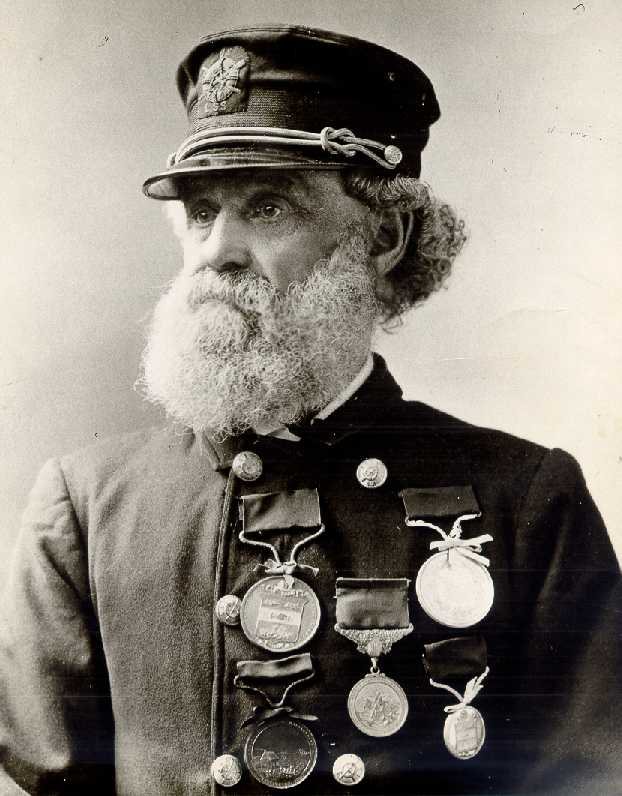
HULL, Mass. On Nov. 22, 1826, Joshua James was born in Hull, the slender peninsula that reaches like a finger into the mouth of Boston Harbor, and for the next 75 years the town and the water around it were the whole of his world. This Nov. 22, a Sunday, is his 200th birthday, and the station he kept still stands on Nantasket Avenue, a museum now to him and the crews he led.
The Hull Lifesaving Museum there credits James and the Hull crews he led with saving more than 1,000 people in 60 years at the harbor's mouth. The men of his own day counted the lives in the hundreds, and when he died the Evening Star of Washington wrote that his death closed "perhaps, the most brilliant career in the world's annals of life saving."
A boy who could hear the land talk
His father, William James, was born in Dokkum, Holland, in 1782 and made his home in Hull hauling paving stones to Boston, according to "Joshua James: Life-Saver," the 1909 biography written by Sumner I. Kimball, the superintendent of the U.S. Life-Saving Service. Joshua was the ninth of 12 children, and the family called him a "great caretaker."
On April 3, 1837, when he was 10, his mother, Esther, and his baby sister drowned when a sudden squall threw the schooner Hepzibah on her beam ends in Hull Gut, and the vessel filled and sank before mother and baby, below in the cabin, could be rescued, Kimball wrote. His sister Catherine, who raised him after that, remembered that "ever after that" he "seemed to be scanning the sea in quest of imperiled lives."
He went to sea as a boy with his father and older brothers and learned the harbor by ear as well as by eye. Kimball recorded a day when James was bringing a yacht into Boston through fog so thick that every bearing seemed lost, and someone asked where they were. "We are just off Long Island head," James said, and when the man asked how he could tell, he answered, "I can hear the land talk." When the fog lifted, they were right off the island.
Sixty years in the boats
James was 15 when he first went out in a lifeboat of the Massachusetts Humane Society, the volunteer service that kept boats and huts of refuge along the state's shore. The museum dates that rescue to Dec. 15, 1841, at the ship Mohawk off Allerton Beach. Kimball placed it on Harding's Ledge early in 1842 and wrote that the vessel's name had long since been forgotten, adding that the society's archives burned in the Great Boston Fire of 1872 and took much of his early record with them.
What survived reads like a ledger of Hull winters, from a bronze medal for rescuing the crew of the French brig L'Essai at Nantasket Beach on April 1, 1850, to the society's May 1876 list naming him keeper of its boats at Stony Beach, Point Alderton (as the society then spelled Point Allerton) and Nantasket Beach and of a hut of refuge on the beach, stocked "with stove, fuel, &c.," that the society noted was "Often misused."
He earned his living lightering and carrying freight, and at 32 he married Louisa Lucihe, 16, who two years earlier had plunged into the ocean to save a girl visiting Hull who had gone beyond her depth. Their house was full of music, with a family orchestra, and Kimball wrote that "many a winter evening was agreeably spent" over chess and checkers.
After he and his crew took 10 people off the brig Anita Owen in the Nantasket breakers near midnight on Dec. 1, 1885, on a night he remembered as "blowing a gale with thick snow and very dark," the society struck a large silver medal for him alone, "for brave and faithful service of more than 40 years in the lifeboats of the Humane Society."
The November storm of 1888
The storm came on Sunday, Nov. 25, 1888, a northeast gale with snow, sleet and towering surf that left wrecks from the Carolinas to Maine, and Kimball wrote that "so terrible a storm in November had never before been known in Hull." Early that day James and a few beachmen climbed Telegraph Hill and watched schooners straining at their anchors through the snow, and by afternoon his volunteers had hauled the crew of the Cox and Green, coal-laden for Chelsea, ashore in the breeches buoy, a rescue seat run out along a line from the beach.
The coal schooner Gertrude Abbott of Philadelphia struck about an eighth of a mile farther along, too far out for the beach apparatus, according to the Life-Saving Service's annual report for the year ending June 30, 1889. Townspeople tore down fences for a great bonfire on Souther's Hill to light the scene, Kimball wrote, and when James warned his men that they might never come back, every one of them offered to go. Between 8 and 9 that night, the federal report says, they launched through "the furious breakers" with two men bailing the whole way and took the eight sailors off at the bow. Coming back in a boat so crowded there was hardly room to row, they struck a rock 200 yards from the beach and rolled one side under, until the sea threw them onto the rocks in shallow water and everyone scrambled ashore. "There are few examples of greater heroism," the report said.
They walked the beach all night, and at daybreak they rowed out to the sunken Bertha F. Walker and took seven men from her rigging, after her captain and mate had been swept away in the dark. Late that morning they reached the schooner H.C. Higginson of Rockland, Maine, sunk about 150 yards off Nantasket Beach with five men in her rigging and the lines from shore hopelessly fouled. James and his crew launched the big surfboat Nantasket, were driven back with two holes stove in her, patched her and went again. One by one the half-frozen sailors tied lines around themselves, jumped into the breakers and were hauled aboard as the crowd on the beach cheered, then rode in carriages to the home of Selectman David O. Wade to be rubbed dry and warmed.
Ten men shared the federal gold lifesaving medal with him for the Gertrude Abbott, among them O.F. James, his son Osceola, then in his early 20s, and the Humane Society's own gold medal honored the captain for "rescuing the lives of twenty-nine persons from four vessels," a count the federal report put at "some twenty-eight."
Keeper at Point Allerton
The storm made the case for a paid federal crew in Hull, and on Oct. 22, 1889, James took the oath as keeper of the new U.S. Life-Saving Station at Point Allerton, Kimball wrote. He was 62, far past the age limit of 45 for new keepers, a rule Kimball said the service waived for him and no one else, after what the museum describes as considerable petitioning by Hull's townspeople. The records differ on when he started: the Coast Guard's station history dates his appointment to Oct. 15, 1889, and the museum dates it to 1890, when he was 63 and the finished station went into service, which Kimball put on March 1 of that year. Asked on his paperwork for the experience that qualified him, he wrote "fisherman," the Coast Guard says.
He was 70 when a sea at the wreck of the schooner Ulrica, on Dec. 16, 1896, pitched him overboard so that the boat passed right over him, and Kimball wrote that he came up clutching an oar, was dragged to the beach and took charge again as if it were part of an ordinary day's work.
Under his charge, Kimball counted, 86 vessels met with disaster within reach of the station, with 556 people aboard, and 16 were lost, all in one night in November 1898 when no boat could reach them. That was the Portland Gale, named for the steamer Portland, lost on Nov. 27, 1898, with all 192 or 193 people aboard by the count of NOAA's Stellwagen Bank National Marine Sanctuary. Kimball, writing in 1909, put her dead at 129, the same as her passengers alone in NOAA's count of 129 or 130 passengers and 63 crew. He wrote that the storm was said to be worse even than the 1851 gale that tore the Minot's Ledge lighthouse from its foundations. James, by then 72, and his crew worked two days and nights, pulling men off wrecks and out of the undertow and bringing in three sailors who had been cast up on Black Rock with the wreckage of their schooner. "We succeeded in getting every man that was alive at the time we started for him, and we started at the earliest moment in every case," he said in his testimony afterward.
The tide is ebbing
On March 17, 1902, seven men of the Monomoy Point station on Cape Cod drowned trying to reach the barge Wadena, and the news affected James deeply, Kimball wrote. Two days later, with a northeast gale blowing, he called his crew out at 7 a.m. to drill in the self-bailing lifeboat, and at 75 he worked the steering oar through the surf for more than an hour. When the boat grounded on the beach in front of the station, he sprang out onto the wet sand, glanced at the sea and told his men, "The tide is ebbing," and fell dead, as Kimball told it. That was March 19, 1902, the date Kimball and the cutter James give and the day before Washington's papers carried the news, though one passage of the Coast Guard's station history puts it at March 21.
He was buried with a lifeboat for a coffin, and a lifeboat made of flowers was laid on his grave, beneath a stone bearing the Humane Society's seal and the words "Greater love hath no man than this," according to the Coast Guard's history of him. The public quickly raised $3,733 for his widow and children, the Coast Guard's station history says.
Where he still keeps watch
His son Osceola went on to captain the steamer Myles Standish between Boston and Nantasket Beach each summer and to lead the Hull volunteers in his father's place, Kimball wrote. Today the Coast Guard cutter James (WMSL 754), based in North Charleston, South Carolina, opens its history page with Joshua James's story, and the Coast Guard's history program still lists Station Point Allerton, the post he opened in Hull, as in operation.
His station at 1117 Nantasket Ave. is now the Hull Lifesaving Museum, which calls him a "father" of the Coast Guard and keeps the surfboat Nantasket, the boat that went out to the Higginson. She spent decades at a museum in Virginia before Hull drew her home through its own streets on May 18, 1985. The museum is open Sundays from 10 a.m. to 4 p.m., with $8 general admission and free entry for children under 5, members, active U.S. service members and their families, and EBT, WIC and ConnectorCare cardholders, its Visit page says.
On his birthday, a Sunday, the museum is scheduled to be open in the station he kept, with the Nantasket inside and the beach where he fell just across the way. Out past the breakers the tide will go out and come back that day as it has every day since he told his crew it was ebbing, and Hull will still be the town of the boy who could hear the land talk and spent 60 years rowing out so that strangers could come home.
Label: Reported by us.
Corrections
No corrections to this story. If something here is wrong, tell us. Every correction is dated on the story and listed in our public log.
Sources (14)
- Sumner I. Kimball, "Joshua James: Life-Saver," American Unitarian Association, 1909, full text via the Internet Archive
- U.S. Life-Saving Service, "Annual Report of the Operations of the United States Life-Saving Service for the Fiscal Year Ending June 30, 1889," pages 29 to 30 and 60 to 63, via the Internet Archive
- Massachusetts Humane Society, "History of the Humane Society of the Commonwealth of Massachusetts," 1876, list of life-boats, mortar stations and huts of refuge, May 1876, via the National Library of Medicine
- Evening Star (Washington, D.C.), "Capt. Joshua James Dead," March 20, 1902, page 13, Library of Congress, Chronicling America
- The Washington Times, "Veteran Life Saver Goes to His Rest," March 20, 1902, page 4, Library of Congress, Chronicling America
- Portland Daily Press (Portland, Maine), "Saved Twenty-Eight Lives," Nov. 27, 1888, page 1, Library of Congress, Chronicling America
- U.S. Coast Guard, USCGC James (WMSL 754) History page, "Captain Joshua James, USLSS," read through the Internet Archive's Aug. 8, 2026 copy
- U.S. Coast Guard History Program, "Station Point Allerton, Massachusetts," read through the Internet Archive's Feb. 9, 2026 copy
- NOAA Stellwagen Bank National Marine Sanctuary, "Steamship Portland"
- Hull Lifesaving Museum, "Joshua James" biography and timeline
- Hull Lifesaving Museum, "Nantasket, Massachusetts Humane Society Surfboat"
- Hull Lifesaving Museum, About and Visit pagesAlso hulllifesavingmuseum.org/visit
- Portrait of Capt. Joshua James, U.S. Life-Saving Service, from the U.S. Coast Guard Historian's Office, via Wikimedia Commons
- Point Allerton station crew photo, U.S. Coast Guard, via Wikimedia Commons

