




Avon will again tax businesses at the highest rate state law allows in fiscal 2027, after the Select Board voted 2-0 Thursday night to keep the town's 1.5 tax shift onto commercial, industrial and personal property.
The assessors' estimates put the residential rate at $13.42 per $1,000 of value, 7 cents above fiscal 2026's $13.35, and the commercial and industrial rate at about $28.89, up from $28.21. Both are estimates until the state Division of Local Services approves them, and Principal Assessor Deborah Ceccarini, an assessing consultant with Vision Government Solutions, told the board they can still move by a penny once the state's final figures are rounded. As of Friday morning, the state's tracking report showed Avon's sales data, values and new growth approved, but not its classification report or its tax rate.
At $13.42, the average single-family home, valued at $573,817 for fiscal 2027, would carry a tax bill of about $7,701, by South Shore 360's math, about $58 more than the fiscal 2026 average of $7,643. A one-cent change in the final rate would move that bill by about $6, and each owner's bill will depend on that home's own new value. It is a far smaller step than last year, when a townwide revaluation lifted values and the average bill rose $850, or 12.5%.
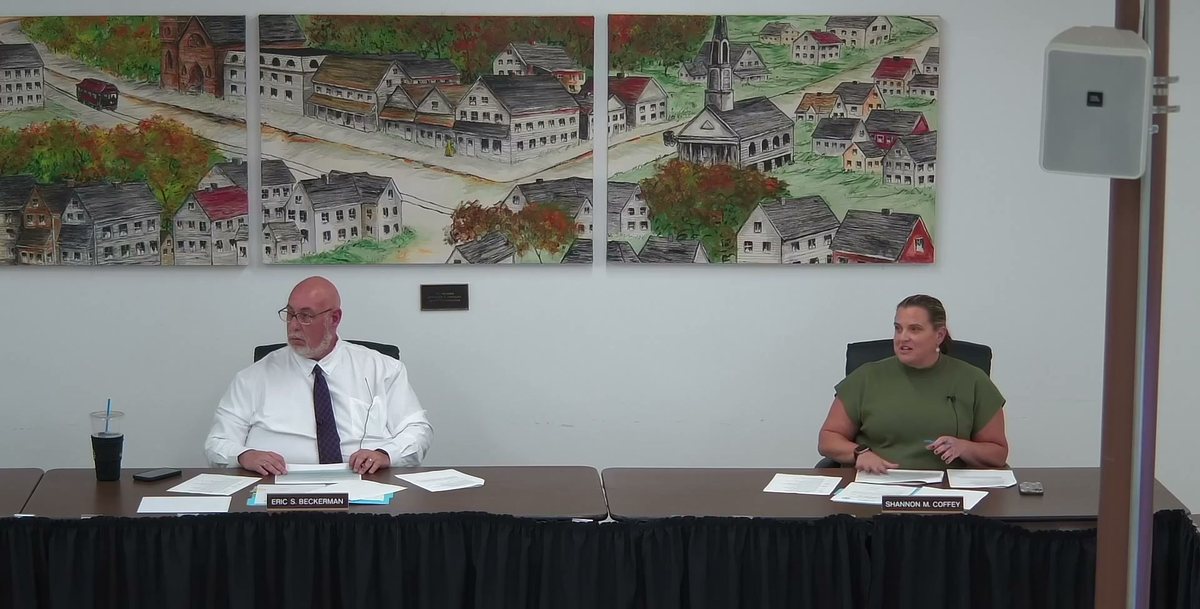
Chair Eric S. Beckerman and Clerk Shannon M. Coffey, the board's two members while its third seat is vacant, voted after a hearing of more than an hour with the Board of Assessors in the Mary McDermott Room at 65 East Main Street.
What the shift does
Avon needs to raise $27,351,719 in property taxes for fiscal 2027, the assessors' figures show, on $1.42 billion in taxable value. Spread evenly, that would be a single rate of $19.23 for every kind of property. Commercial, industrial and personal property, the classes businesses pay, make up about 37.6% of Avon's taxable value, a share Ceccarini called rare, since homes make up 85% to 95% of the value in most Massachusetts towns.
By adopting a residential factor of 0.6977, the lowest the state allowed Avon for fiscal 2027, the board moved those properties to 150% of the share they would carry under a single rate. That shifts about $5.1 million of the levy off homeowners, so businesses pay about $15.4 million, roughly 56% of the total, and homes about $11.9 million. For a $500,000 home, Ceccarini said, a single rate would mean a bill of about $9,600, against about $6,700 at the split rate. The assessors estimate the average commercial bill will rise about 6.4% and the average industrial bill about 5.6%. Ceccarini said the state has let a few communities shift more than 1.5 but not Avon, and the assessors told the board the town could consider asking the state about it next year; it was not an option for fiscal 2027.
The rate is rising even though new growth was strong. Avon added $627,639 in new tax revenue from new construction and other growth, according to the state's figures, most of it from personal property, which Ceccarini said came largely from an Amazon facility in town, two solar arrays and utility property. She told the board fixed costs such as school assessments and health insurance rose by more than that. The levy is up about 4.6% from fiscal 2026 while taxable value rose about 2.1%, and it stays about $1.08 million under the most the town could legally raise.
The board also voted not to adopt a residential exemption or an open space discount, and to keep the small commercial exemption, which takes 10% off the value of eligible small businesses. Ceccarini said 18 businesses qualify and that Avon is one of only 15 communities in the state that grant it.
What residents said
A West High Street resident told the board his taxes and heating costs keep climbing and that he plans to leave town once his child finishes school. "I just can't afford to live here anymore," he said. A Spring Street resident who joined by Zoom said that after last year's increase she had to switch home insurance companies.
A business owner who spoke said companies already carry the largest share of the levy. "We're already at the max," he said.
Coffey answered that the board cannot shift any more of the levy onto businesses than the state allows, and said she presses department budgets to hold down spending increases. Beckerman said the board has told the town administrator and department heads, in the middle of budget season, to come back with reductions rather than increases. He said regionalizing services is the only way to cut the budget significantly, and that schools and health insurance are the biggest costs. "People in this town want their own services," he said. "We've got to pay for the services."
Ceccarini said fiscal 2027 values are certified, but the online property cards will show last year's values until January, so owners who want their new value can get a copy of their card at the assessors' office in Town Hall.
Water: hydrant fee doubles, tier lines drop
The board also set water rates, choosing the most modest of three options from the town's rate consultant. The semiannual service charge stays at $100 and the price for each tier of use stays the same, but the lines between the tiers drop from 1,400, 4,000 and 8,000 cubic feet to 1,000, 3,000 and 6,000, so households that use more water will see more of it billed at the higher tier prices. The fee for each of the town's 93 privately owned fire hydrants, such as those behind businesses, doubles, from $100 to $200; the consultant said that fee had not changed in at least 10 years while the other charges rose.
The consultant said water rates now bring in about $1.12 million a year, about $125,000 short of a $1.245 million budget target, and the option the board chose closes just under $80,000 of that gap. Coffey said raising the service charge, the rates and the tiers all at once would be "an undue burden on people." Officials said bills from the September meter reading will go out at current rates, and the changes will first show up on bills after the March reading.
What happens next
The assessors send the board's votes to the Division of Local Services, which must approve the classification and the tax rate before Avon can issue bills at the new rate.
Homeowners who think their new value is wrong can apply to the assessors for an abatement once the third-quarter bills are mailed; for fiscal 2027 the filing period runs until Monday, Feb. 1, 2027, and no application is accepted after that. The town also offers personal exemptions, among them $1,000 for qualifying seniors, $900 to $1,800 for qualifying veterans and $600 for blind residents, and a senior work-off program that credits up to $1,000 on the tax bill of a homeowner 65 or older for 100 hours of work for the town. The forms are on the assessors' pages of the town's website.
South Shore 360 asked Town Administrator Jonathan L. Beder on Thursday morning, before the meeting, for the assessors' presentation and the proposed water rates. He had not answered as of Friday morning. At the meeting, Beder offered to post the consultant's water rate study online for anyone interested.
Avon is among the South Shore communities still waiting on state approval of their fiscal 2027 rates, and South Shore 360 keeps a running tally of the towns with new rates and their average bills.
Label: Reported by us.
Corrections
No corrections to this story. If something here is wrong, tell us. Every correction is dated on the story and listed in our public log.
Sources (10)
- Avon Community Access (avontv.org), livestream of the Nov. 19, 2026 Avon Select Board meeting on Live Channel 9; show page: "Avon Select Board Meeting - Tax Classification 11-19-26"
- Town of Avon, Select Board amended agenda for Nov. 19, 2026, posted Nov. 17, 2026, read Nov. 20, 2026
- Town of Avon, Select Board members and Board of Assessors, read Nov. 20, 2026
- Town of Avon, fiscal 2026 tax rates, read Nov. 20, 2026
- Town of Avon, Board of Assessors exemptions, abatement forms and Senior Property Tax Work-Off Program, read Nov. 20, 2026
- Massachusetts Division of Local Services, Tax Rate Status, Avon, fiscal 2027, status as of Nov. 20, 2026
- Massachusetts Division of Local Services, New Growth, Avon, fiscal 2026 and 2027, read Nov. 20, 2026
- Massachusetts Division of Local Services, Excess Levy Capacity, Avon, fiscal 2025 to 2027, read Nov. 20, 2026
- Massachusetts Division of Local Services, Average Single-Family Tax Bill and Tax Rates by Class, read Nov. 19, 2026
- Massachusetts General Laws, Chapter 40, Section 56