




BRAINTREE, Mass. A part of Braintree that takes in South Braintree Square, the Ivory Street corridor and Braintree station becomes a federal Opportunity Zone on Jan. 1, 2027, opening a tax break for investors who put their capital gains into property and businesses there over the next 10 years.
Mayor Erin V. Joyce announced the designation Wednesday, Nov. 18. The U.S. Treasury Department and the IRS released the national list on Nov. 5: 6,576 census tracts, all of the tracts states nominated, designated for 10 years starting Jan. 1. Braintree's is census tract 4198 in Norfolk County, one of 104 Massachusetts tracts on Treasury's list. The state nominated it, and it is the first time a Braintree tract has been named an Opportunity Zone, the town said.
"Receiving this Opportunity Zone designation from the U.S. Treasury is a major milestone for Braintree's long-term financial stability and economic vitality," Joyce said in the town's release. She said it "gives us a transformative tool to attract private-sector partners, create local jobs, expand housing options, and generate sustainable new revenue that strengthens our community without overburdening local taxpayers."
Who gets the tax break
The break goes to investors: a person or company that sells stock, real estate or another asset at a profit can put that gain into a Qualified Opportunity Fund, which in turn invests in buildings or businesses inside a designated tract. The funds put that money into "commercial redevelopment, housing creation, and local business expansion," the town's release says.
Federal law, as Congress rewrote it in July 2025, sets these terms for money invested after Dec. 31, 2026. The tax on the original gain is put off until the fund investment is sold, or for five years, whichever comes first. An investment held five years has its basis raised by 10% of the deferred gain, so that share of the gain goes untaxed; the figure is 30% for investments through a qualified rural fund, and Braintree's tract is not rural. An investor who holds for at least 10 years can elect to pay no tax on the fund investment's own growth when it is sold, covering up to 30 years of growth.
The tax benefits go to taxpayers who invest in a designated tract, Treasury's Office of Tax Analysis says. For people who live or run a business in the tract, the designation by itself does not change property tax assessments, zoning or permitting, Braintree Economic Development Director J. Catherine Rollins said in written answers to questions from South Shore 360.
"Nobody's property taxes go up or down because of this designation, and local land-use authority stays completely in Braintree's hands," Rollins wrote. Any future project in the area "will still go through the exact same local permitting, public hearing, and zoning review processes as anywhere else in Town," she said.
She described the incentive as "a powerful new tool to encourage reinvestment in underutilized commercial properties, which can help bring new foot traffic, cleaner streetscapes, and upgraded infrastructure that benefit the area and our existing small businesses over time."
Why this tract qualified
A tract can be named only if it counts as a "low-income community" under federal law: its median family income is no more than 70% of the surrounding area's, or its poverty rate is at least 20% and its median family income is no more than 125% of the area's.
Tract 4198 cleared the first test narrowly, with Treasury's data putting its median family income at $99,712, about 68.4% of the Boston area's $145,780, from the Census Bureau's 2020 to 2024 American Community Survey, and its poverty rate at about 7.6%.
What is in the zone
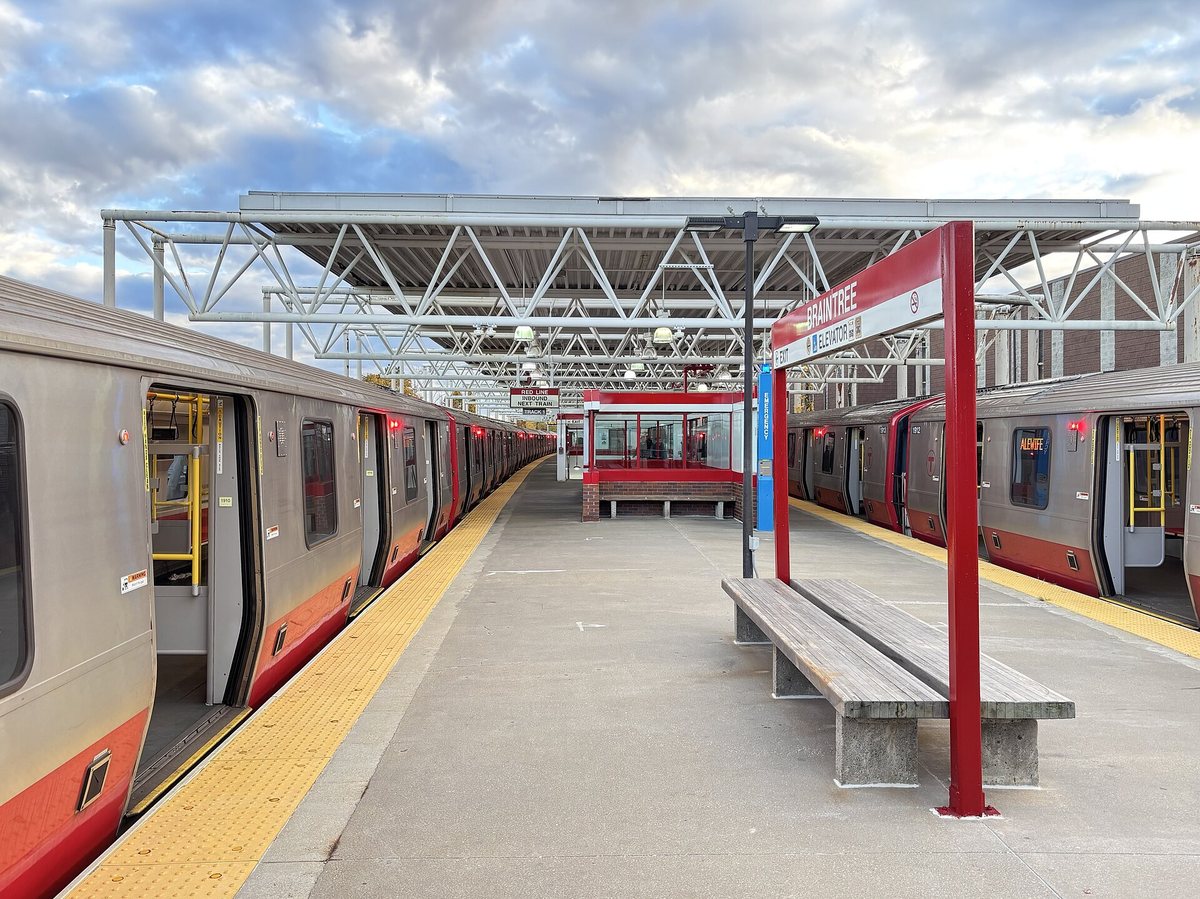
The town's map shows the tract taking in South Braintree Square, the Ivory Street corridor and "significant commercial property," with direct links to Route 3, the commuter rail and the Red Line, whose Braintree station sits inside the tract. The capped landfill site on Ivory Street, across from the station, is in the tract too, Rollins said.
The designation comes alongside three state grants the town recently received for the area, the release says: a $483,000 MassDevelopment Site Readiness grant for a Phase 1 environmental assessment of that landfill, a figure Rollins confirmed; $150,000 from the state Executive Office of Housing and Livable Communities to plan the future of South Braintree Square; and $562,650 from the same office to replace and rebuild the water main at the Plain Street bridge. The Town Council voted unanimously Tuesday, Nov. 17, to accept all three, according to the meeting's recording, and Rollins confirmed the acceptance. South Shore 360 reported on the grants Nov. 14, when they went on the council's agenda.
Joyce's memo to the council tied the water main work to "the approved 752-unit transit-oriented housing development at 10 Plain Street." That site "is partially located within the Opportunity Zone," Rollins, the town's economic development director, wrote in a follow-up answer Friday. Under IRS rules for real property that straddles a zone, an Opportunity Zone business can treat the whole property as inside the zone when it uses both parts, the two parts adjoin, and the part inside is the larger share by square footage or by cost, measured when the property is bought.
Asked which sites the town will bring to Opportunity Fund investors and whether any investor or developer has shown interest, Rollins did not name a particular site or investor. "Rather than focusing on a single parcel, we are taking a comprehensive approach," she wrote, pointing to "significant transit-oriented potential right around the Braintree MBTA station and highway network in the Ivory Street corridor." She said the designation "is brand new, and as we roll out our marketing outreach over the coming months, we expect strong interest from Opportunity Funds looking for high-access, transit-connected communities just outside Boston."
"By combining strategic municipal planning with federal tax incentives, we are creating an environment where businesses want to invest, grow, and put down roots," Joyce said in the release, thanking the Healey-Driscoll administration and the state and congressional delegations.
What comes next
Rollins said the town sees the designation "not as a standalone silver bullet, but as one piece of a much broader, proactive economic development strategy that is already underway." The $150,000 Community Planning grant for South Braintree Square is meant to produce "a clear community-driven roadmap for public improvements and private investment" for the district, she said, and "this planning and engagement process will launch early in the new year."
The landfill assessment is set to run from December 2026 through May 2027, with crews digging test pits and drilling borings at the Ivory Street site to learn what is underground, and the mayor's office will share updates and early findings with the public, the town says.
The town directs businesses and developers interested in the area to Rollins at crollins@braintreema.gov, or to its Braintree Forward site.
Elsewhere on the South Shore
Braintree's is one of five tracts on Treasury's list in the 26 communities South Shore 360 covers, by our check of the list against Census Bureau maps. Three are in Brockton, and one in Plymouth is the only one of the five Treasury lists as rural, where investors using a qualified rural fund can get the larger 30% break.
The designations run through the end of 2036, and Treasury's full list and map are posted by its Community Development Financial Institutions Fund.
Label: Reported by us.
Corrections
No corrections to this story. If something here is wrong, tell us. Every correction is dated on the story and listed in our public log.
Sources (14)
- U.S. Treasury Designates Strategic Area of Braintree as Opportunity Zone, press release, Office of the Mayor, Town of Braintree, Nov. 18, 2026, linked from the town's news post (https://braintreema.gov/CivicAlerts.aspx?AID=1072)
- Written answers from J. Catherine Rollins, Economic Development Director, Town of Braintree, to questions from South Shore 360, emails, Nov. 20, 2026, 9:37 and 11:34 a.m. (no web copy); her title from the Town of Braintree staff directory, read Nov. 20, 2026
- Treasury, IRS announce Opportunity Zones designations for over 6,500 communities across America, IR-2026-132, Internal Revenue Service, Nov. 5, 2026
- 2027 QOZ Designations data file, U.S. Department of the Treasury, Oct. 30, 2026
- Eligible LICs for Nomination as 2027 QOZs data file, with each tract's poverty rate and median family income, U.S. Department of the Treasury, Oct. 30, 2026
- Eligibility Criteria for Determining Census Tracts Eligible to be Nominated as 2027 Qualified Opportunity Zones, Treasury Office of Tax Analysis, October 2026
- 26 U.S. Code section 1400Z-2 with the 2025 amendments, Pub. L. 119-21, section 70421, Legal Information Institute, Cornell Law School
- 26 CFR 1.1400Z2(d)-1, paragraph (d)(3)(ix), real property straddling a qualified opportunity zone, Legal Information Institute, Cornell Law School
- Census tract locations, TIGERweb, U.S. Census Bureau, and the Census Geocoder, read Nov. 18, 2026
- Braintree station, MBTA
- Town Council agenda and meeting packet, Town of Braintree, Nov. 17, 2026, including the mayor's Oct. 27 memo on the Plain Street water main grant and the town's Ivory Street landfill assessment FAQ (October 2026)
- Braintree Town Council meeting, Nov. 17, 2026, recording, BCAM TV, for the three grant votes
- Opportunity Zones list and map, CDFI Fund, U.S. Department of the Treasury
- Braintree council votes Tuesday on $1.2 million in grants for the Ivory Street landfill and Plain Street, South Shore 360, Nov. 14, 2026